copper crystals, pollucite, argyrodite, chrysoberyl, cassiterite, hausmannite, inesite, arsenopyrite
Please refer to this page as C4
|
|
|
|
Rudni, Kazakhstan An impeccable gemmy yellow twinned crystal group, far better than picture shows, 6cm accross. . . #mcalRud . .SOLD |
Copper, highly crystalized, Itouze mine, Kazakhstan. SOLD A remarkably well crystallized miniature displayable both sides, 45mm long . . Note: this was by far the best ...and most expensive...of a group that we were given the privelege to preview straight from the miner who got them from Kazakhstan. we have at times gotten more but none anywhere as well crystallized and this. |
|
|
|
|
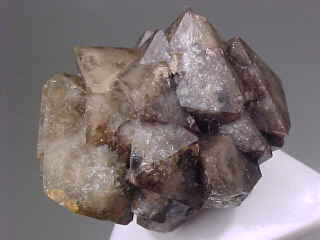
Palos Verdes, Los Angeles County, California Very well formed crystal cluster of the kind that is hard to get any more (know from having collected there myself) From Hemel Collection , 12 cm #mbarPV . $80. |
Kuruman, Cape Prov. South Africa. a 7 cm specimen with lustrous crystals to 3 cm . . .SOLD |
|
|
|
|
One crystal to 4 cm with smaller parallel crystals on the side all included with red hematite but to different extents around the specimen; whole is 7 x 5.5 cm . . $75 |
|
|
|
|
|
highly crystallized lustrous specimen, 5 x 3.5 cm . . $50 SOLD |
A couple of saft hemispheres of this rather rare mineral on matrix 4.5 x 4. 5 cm . . $85 |
|
|
|
|
Crystals of this very rare Silver-Germanium mineral on matrix; whole is about 2 cm across. We chemically check each piece for silver AND germanium to ensure it is authentic . . $75 Regarding Argyrodite, it is of historic importance because it is in this mineral that the element Germanium was discovered. If one were to digress a little on Germanium, one may add that it had been predicted by the young British chemist Newlands in 1864 as the missing element in a triad between Silicon and Tin. Seven years later the much older Russian Mendelev specified the properties it should have using his newly devised Periodic Table of the Elements. A hunt got under way by inorganic chemists and to be brief, in 1886 Winkler found it and named it in honor of his country. The source was Argyrodite. Lest it be thought that this was a straightforward process, one might mention that Winkler having isolated it, nevertheless assigned it the wrong place among the then missing elements! It was not untill some time later that another German chemist Lothar Mayer (now of Latharmayerite fame) recognised its proper identity and position in the Periodic Table that the case on Germanium was finally concluded. |
A heavy white mineral far more interesting as a result of its rarity and composition than its appearance. Some crystal faces. Pollucite is a rare mineral of Cesium . . Your one minute cesium education: Cesium is the most reactive of all metals. It ignites spontaneously in air and explodes instantly in water. (Actually rather more reactive than sodium!) The lustrous metal, usually stored in vacuum or nitrogen, has a light brassy color and a melting point low enough that it melts in hot weather. It has important uses in photocells because light causes it to eject electrons (this is how the sound track of cinemas works). Has other uses too like Cs137 but the minute is up! For more info look it up in a chemistry text or on the the Web! |
|
|
|
|
|
|